The Impact of AI on Jobs and Relationships

The rapid rise of automation and artificial intelligence (AI) is reshaping the world in ways that were once relegated to science fiction. As machines become smarter and more capable of performing tasks traditionally done by humans, it’s crucial to explore the far-reaching implications of this technological revolution. This essay will examine the effect of automation and AI on the job market, personal relationships, government interventions, the possibilities of Universal Basic Income (UBI), finding meaning after employment, and what parents can teach their children to prepare them for a future dominated by AI and automation.

The Job Market: Displacement and Transformation

One of the most immediate effects of automation and AI will be felt in the job market. According to various studies, millions of jobs across industries—ranging from manufacturing to service-oriented roles—are likely to be displaced by automation. Tasks that are repetitive, manual, or require basic decision-making are especially susceptible. In the automotive industry, for example, robots already perform much of the assembly work. Likewise, AI-driven technologies such as chatbots and algorithms are beginning to replace customer service representatives and data analysts.

However, it’s important to note that while some jobs will be lost, new ones will emerge. The creation of new industries and roles—such as AI specialists, data scientists, and automation engineers—will require a shift in the workforce. People may need to acquire new skills and adapt to a rapidly changing landscape. The future of work might be more focused on tasks requiring emotional intelligence, creativity, and complex problem-solving, which AI cannot easily replicate.

This transformation in the job market presents both challenges and opportunities. While some workers may face difficulties transitioning to new roles, others will benefit from the advancements in technology, particularly in the tech sector and industries that harness AI to drive innovation.

Personal Relationships in the Age of AI

The rise of AI and automation will inevitably influence personal relationships in complex ways. On one hand, automation could free people from the burden of repetitive and time-consuming tasks, allowing them more leisure time to spend with family and friends. The possibility of a more leisurely existence could foster deeper relationships, as individuals are able to focus on personal connections rather than the grind of work.

On the other hand, the increasing prevalence of AI in personal spaces, such as in the form of virtual assistants, autonomous vehicles, and AI-powered therapy bots, could alter the dynamics of human interaction. As AI systems become more adept at mimicking human behavior, there is a risk that people may start to rely on machines for emotional support and companionship. This could lead to feelings of isolation or a diminished sense of authentic human connection.

Furthermore, with a rapidly changing economy, some families may experience stress and disconnection as the roles of breadwinners and caregivers evolve. This change may also place additional pressure on individuals to maintain emotional resilience and adaptability in a world that is increasingly shaped by automation.

Government Intervention: Policy and Regulation

As the workforce changes and the effects of automation on society become more pronounced, governments will be faced with critical decisions on how to manage these transitions. Policymakers will need to enact policies that support workers displaced by automation, such as retraining programs and social safety nets. Governments may also be required to regulate AI technology to prevent monopolistic practices and ensure that its benefits are widely shared.

In particular, there is growing interest in the idea of Universal Basic Income (UBI), a policy proposal where the government provides all citizens with a regular, unconditional payment to cover basic living expenses. The argument for UBI is that as AI and automation reduce the need for human labor, UBI could provide a financial cushion for individuals who lose their jobs. By ensuring a stable income, UBI could also promote creativity, entrepreneurship, and personal growth, as people would no longer be beholden to traditional employment for survival.

Despite the potential benefits of UBI, implementing such a program presents challenges. Funding UBI could require significant taxation and a rethinking of current social welfare systems. Moreover, there are concerns about whether UBI would encourage or discourage work, and whether it would address the underlying issues of wealth inequality.

Finding Meaning After Employment

As automation takes over many of the tasks that once provided individuals with a sense of purpose, the question of what gives life meaning will become more pronounced. For centuries, employment has been central to people’s identity. A person’s job often dictates their social status, financial security, and sense of contribution to society. With AI and automation taking over many roles, people will be forced to grapple with the idea of meaning beyond work.

In this new world, individuals will need to find meaning through non-work-related pursuits. This could mean investing more time in family, hobbies, and community-building. People may seek personal fulfillment through creative expression, education, or spiritual growth. Philosophical questions surrounding the purpose of life and the role of human beings in an increasingly automated world will likely gain prominence.

The challenge will be to create a society where people are not defined solely by their economic productivity. To this end, fostering a culture that celebrates human creativity, emotional intelligence, and community engagement will be essential to finding fulfillment in a post-work society.

Preparing Children for a World of AI and Automation

As the world shifts toward automation and AI, it’s essential for parents to prepare their children for this new reality. In many ways, the skills that will be most valuable in the future are those that cannot easily be replicated by machines. Critical thinking, emotional intelligence, creativity, and the ability to adapt to new challenges will be crucial.

Parents can emphasize the importance of learning how to learn, encouraging curiosity and a growth mindset. While traditional academic skills will still be important, fostering a love for problem-solving, collaboration, and innovation will ensure that children are well-equipped to navigate a rapidly changing world.

Moreover, exposure to technology from an early age will be critical. Children who grow up understanding the basics of programming, artificial intelligence, and data science will have a competitive edge in a future that revolves around these technologies. It is equally important for parents to teach children about the ethical implications of AI and automation, ensuring they develop a strong sense of responsibility and empathy in their interactions with machines and fellow humans.

Conclusion

The coming of automation and AI represents both an exciting and challenging shift in society. As machines increasingly perform tasks once reserved for humans, individuals, families, and governments will face new questions about work, meaning, and identity. While the changes in the job market and personal relationships will be significant, they also present opportunities for greater creativity, fulfillment, and innovation.

By preparing future generations to thrive in a world shaped by AI, teaching them to adapt, think critically, and work collaboratively, we can ensure that the coming era of automation is one in which humanity flourishes—not just survives. The future is uncertain, but with thoughtful planning and a focus on human-centered values, we can shape a world where technology empowers rather than diminishes the human experience.

Future of Manufacturing: Trends Shaping 2025-2035

The landscape of manufacturing in the United States is poised for significant transformation over the next decade. As we look ahead to 2025-2035, key factors such as the continued implementation of tariffs under the Trump administration, the rise of automation, the advent of 3D printing, the expansion of dark factories, and the introduction of humanoid robots will shape the nature of manufacturing jobs. These developments will fundamentally alter the workforce, the economy, and the very structure of the industry. However, the effects on manufacturing jobs will be complex, with both positive and negative outcomes for workers.

The Influence of Tariffs

The Trump administration’s tariffs on foreign-made goods, a policy set to persist under future administrations, will continue to exert pressure on global supply chains. These tariffs are designed to incentivize American companies to shift their production back to the U.S., potentially reviving some manufacturing jobs that had previously been outsourced to countries with lower labor costs. On the surface, this “reshoring” effort might create new employment opportunities in certain sectors, particularly for industries like steel, textiles, and electronics.

However, the impact of these tariffs on jobs will be tempered by the need for companies to maintain competitiveness. Higher tariffs may increase production costs, which could lead to price hikes or force manufacturers to find ways to remain competitive without expanding their workforce. This may result in a shift toward more advanced manufacturing technologies, including automation and artificial intelligence (AI), to keep costs down and output efficient.

The Rise of Automation

Automation has already made significant inroads into U.S. manufacturing, and this trend will only accelerate in the coming decade. Robots are increasingly taking over repetitive and dangerous tasks, from assembling parts to packaging products. By 2035, many factory floors may operate with minimal human intervention, with robots performing the majority of labor-intensive work. While this may seem like a threat to traditional manufacturing jobs, it also opens up new opportunities for skilled workers who can design, program, maintain, and oversee these automated systems.

However, the shift toward automation will likely lead to the elimination of many low-skill, manual labor jobs in factories. For workers without the skills to transition into new roles, automation presents a significant challenge. The U.S. will need to focus on reskilling and upskilling initiatives to help these workers move into the technology-driven jobs that will emerge. The growing demand for workers with expertise in robotics, data analytics, and AI could offset some of the job losses, but a large-scale retraining effort will be required.

3D Printing and Customization

3D printing is poised to revolutionize manufacturing in ways that are already visible in industries like aerospace, automotive, and healthcare. The ability to produce customized parts on-demand and locally will reduce reliance on large factories and international supply chains. By 2035, we may see decentralized manufacturing hubs, where smaller, localized 3D printers are used to produce everything from medical implants to consumer electronics.

This decentralization of manufacturing could reduce the number of traditional factory jobs in centralized industrial hubs, but it will also create new opportunities. Small-scale 3D printing operations could give rise to a new breed of entrepreneurs and workers who specialize in customizing and producing parts locally. This shift may also spur the creation of jobs in design, quality control, and machine maintenance for these advanced printers.

Dark Factories: The Shift to 24/7 Production

The concept of dark factories, where production runs 24/7 without human workers on-site, is another crucial development for the future of manufacturing. In these fully automated factories, AI, robotics, and sensors manage all aspects of production. While human presence is limited to overseeing operations remotely, these facilities allow manufacturers to operate around the clock with minimal downtime.

Dark factories will likely lead to a reduction in the overall number of human jobs needed for physical production. However, there will still be a demand for skilled workers to design, manage, and troubleshoot these systems. Jobs in system monitoring, AI training, and remote maintenance will likely increase. Furthermore, the need for cybersecurity specialists to safeguard these highly automated operations will be crucial as factories become more dependent on digital infrastructure.

Humanoid Robots: A New Era of Human-Robot Collaboration

Perhaps one of the most fascinating prospects for manufacturing in the coming decade is the use of humanoid robots. Unlike traditional industrial robots that operate in fixed, predefined ways, humanoid robots will be designed to work alongside human employees, collaborating in real-time to complete complex tasks. These robots will be able to handle delicate tasks that require dexterity and adaptability, such as assembly, inspection, or packaging in industries where human workers traditionally excelled.

The integration of humanoid robots into manufacturing will redefine job roles. Workers will likely transition into supervisory, coordination, or design roles, where their expertise will complement the abilities of these robots. While the rise of humanoid robots may reduce the need for certain low-skill manual labor positions, it could also generate new opportunities in robot development, programming, and management.

Conclusion

The manufacturing jobs of 2025 to 2035 will look vastly different from those of today. Tariffs and reshoring efforts may help revitalize some industries, but the increasing reliance on automation, 3D printing, dark factories, and humanoid robots will reduce the demand for traditional manual labor. As jobs evolve, so too must the workforce, which will require investment in education and reskilling programs. While the future holds the promise of greater efficiency and innovation in manufacturing, it also presents significant challenges in terms of job displacement and the need for workers to adapt to a new technological landscape. If managed correctly, however, this transformation could lead to a more dynamic, tech-driven manufacturing sector in the United States, providing new opportunities for those ready to embrace the future.

Adapting to Change: Mental Health and the Future of Work

Even though I don’t go out or socialize in person much anymore, I still keep busy. I was recently demonetized on Medium. No explanation and no way to appeal. Really irritated me as I was making some decent money.

In some ways, they did me a favor forcing me back into Word Press on a regular basis. Even though I haven’t been posting much over the past year or so, I was still getting a decent amount of audience. Some days I would check, and I would have 40 or so views on a single day even though I hadn’t posted in weeks. Maybe the word is getting out there.

Sure, I made more money on Medium. But I got better audiences on Word Press. But I guess nothing lasts forever. There were also a lot of complainers and whiners on Medium. I don’t miss them. First World problems in most cases. I swear people like that never had to deal with bullies and setbacks as kids.

I was bullied a lot as a kid. Ended up in several fights, most of which I lost. But I’m glad I went through it. Made me confident in my ability to survive and adapt, especially as I got older. No I didn’t enjoy it at the time. But I thank God every day I dealt with some hardship as a kid during prosperous times.

I was born in 1980 and spent most of my formative years in the 1990s. We still had the latch key kind of things. I had my freedom, like most small-town kids. And the grownups usually let the kids solve their own problems unless we got too destructive or violent. Much of that behavior would be considered child abuse these days.

Personally, I think real abuse is sheltering kids from the consequences of their actions, not teaching them how to cook or do basic repairs to household items or never letting them solve their own problems. Hitting your kids isn’t the only form of child abuse out there. I think not preparing them for adulthood and its ups and downs is every bit as abusive as punching them in the face.

In some ways I’m glad I didn’t have kids or get married. But that is mostly because of the schizophrenia. While I don’t particularly enjoy living with my elderly parents, I know I would enjoy living in a nursing home (been there, done that) or being homeless would be even worse. It’s a blow to my pride that I live with my parents after being on my own for seventeen years. But I try not to complain, at least publicly, because I know it could a lot worse.

I’ve always taken mental health seriously. Even more so now with everything changing so rapidly. I’m under no delusion that I’ll ever make enough money to support myself off writing. Vast majority of even paid writers don’t make above poverty level wages off writing alone.

I’m kind of burned out on computer games. And almost every time I try to socialize with anyone outside of immediate family, these people are in awful moods all the time. Nothing can make most people happy.

These people are going to be really unhappy in a few years when AI and automation take more and more jobs, especially since we have almost nothing for social safety nets. Rest assured; it will happen. A lot of people will eventually lose their jobs to AI and automation. I’ve been trying to tell people this for over a dozen years. About the only people who listened are my retired elderly parents and my best friend. She’s always grumpy and grouchy now, it’ll only get worse when she loses her good paying job she’s complains about almost daily.

I know it sounds like I don’t sympathize with these people whose jobs are on the robot chopping block. But you would be wrong. I lost my career and everything I worked for many years ago due to my mental illness. I did everything right; worked hard in school, stayed away from drugs, stayed away from credit cards, stayed out of trouble, etc. And I still lost everything.

Millions of people will find themselves in the same boat within several years. Not their fault a machine can probably do their jobs better than they ever could. Soon they will be cheaper too. In my case I lost my career in my twenties rather than my forties when I would have had a mortgage, a couple kids to send to college, and a retirement to save for.

In spite being surrounded by grouches, I’m looking forward to Christmas. I didn’t ask for any special gifts. I think a large dinner of spiral ham, stuffing, green bean casserole, etc. is enough of a gift. Don’t know how many Christmases I have left, but I intend to really enjoy this one. It’s just too bad that it doesn’t snow much down here in Oklahoma City.

The Future and AI and Automation from A Mentally Ill Point of View

Been studying up on Automation, Robotics, and AI for most of the last year and a half. At least, that’s when I got serious into tech stocks. Tesla, Nvidia, Palantir, and AMD were some of the big ones I got in on. Made good profits so far with all of them but AMD.

Been watching a lot of videos on AI and Automation on YouTube the last several months. My favorites include David Shapiro, Julia McCoy, Issac Arthur, Peter Diamandis, Ray Kurzweil, among others. Currently reading the recently released ‘The Singlualrity is Nearer’ by Ray Kurzweil. Reread the original ‘Singularity is Near’ back in the winter.

It’s insane how fast all of this is unfolding. Makes me think the real bottle neck in AI and Automation advances won’t be programming, learning models, or even microchips anymore. I’m now thinking the real bottlenecks will involve physical infrastructure for data centers and even availability of electrical power and water.

A friend of mine works for a landlord who already uses AI for much of their office work and tenant services. She thinks she probably will be replaced by automation eventually. But she’s been preparing for an out for years just in case something like mass technological unemployment does happen.

As it is, I’ve been out of the job market since 2012 due to schizophrenia. Even though I found minimum wage working too overwhelming for my illness to manage (I used to violently vomit from the anxiety of going to work every day when I worked in retail and fast food), I have found other things to occupy my days. Just because I’m on disability doesn’t mean I drink beer and father children I can’t take care of. I’d love to see that trope die.

Over the years of not having a regular job, I’ve taught myself several subjects. Namely literature, writing, economics, finance, history, some science, studied on tech advances, futurism, etc. Got some of my Spanish up to date. Foreign language is one of those ‘use it or lose it’ kind of deals.

One thing I did teach myself was investing. Turns out I’m pretty good at it. I do think most people, certainly here in the US, are too short-term thinking to succeed in the market. I’ve seen it in my own family. I’m learning from their mistakes.

I originally went to college with the idea of going into medical research. Turns out that AI can do research pretty well. It can also write reports and even short stories pretty well due to ChatGPT. AI can do a lot of the academic work I wanted to do in my youth already. It’s not going to get any worse.

Even my skills with picking investments are surpassed by AI. And most of the companies with huge gains and profits the last couple of years are AI and Automation companies.

Companies are laying off thousands of workers even though they are profitable. I’m dead convinced these jobs are being automated away. Much like the factory jobs of decades ago, white collar office jobs are starting to get cut.

I do think the far future will be a really cool and excellent place. Yet, we seem to have zero plan as how to get there with as little disruption as possible. I’m convinced we are going through upheavals and changes now as big as the Agriculture and Industrial Revolutions of past eras.

I think there will a lot of pain involved in this transition. And hardly any politician is talking about this publicly. I saw that Greece recently legalized a six-day work week. That’s not even going to be relevant in five to ten years once automation is good enough to take the majority of jobs.

Don’t think for one moment that businesses will keep on human employees if they don’t have to, certainly not in the numbers they currently do. The fact that slavery was legal and accepted for most of civilized history alone proves bosses don’t want to pay workers unless they absolutely have to. Now, the slaves will be algorithms, chatbots, AI, machines, and robots.

Speaking of robots, Tesla recently announced they will start building humanoid robots to serve as common laborers. This isn’t science fiction or fake news. This is happening right here and right now. And most people are still in denial or don’t realize just how good the tech already is.

The bottlenecks of power requirements will slow down the real-world implementation, at least temporarily. Self-driving cars and trucks are already here. Heck, even my brother owns a Tesla with self-driving capacities.

Satellites and drones are already doing agriculture work. A farmer friend of mine back in Nebraska has owned a self-driving tractor that can navigate by GPS for at least five years. The future is already here, it’s just not evenly spread out yet.

As far as power goes, the growth in solar and wind power implantation has gone almost parabolic in the last several years. Next generation nuclear is already being prototyped in many places. And China has already built some thorium powered nuclear plants. Pity the USA and USSR gave up on thorium years ago.

We have all this science and tech advancing at breakneck pace. Something new comes out almost every day now. Our science and tech are pointing us to the future. It’s the social and politcal attitudes that want to drag us back into the ‘good ol days.’

Screw the good old days. They sucked for almost everyone. That is unless one was rich, a ruler, or a member of a privileged class and race. I swear our science and tech says The Jetsons while our politics are screaming Huckleberry Finn. It’s an insane paradox.

I grew up in the pre internet days. I’ll be damned before I go back.

Yet Even More of What’s Been on My Mind Since I Moved to Oklahoma City

Talked to an old childhood friend earlier tonight. She was telling me stories about the horrors she deals with everyday at her job in a pharmacy in a college town in the midwest. Caught one of her coworkers smoking pot while on the clock recently. Her boss did nothing. No write up, no drug test, no firing, no verbal reprimand. I’ve been listening to horror stories about working in customer service from my friends, people on reddit forms, youtube videos, etc. for the last ten years. I have a few stories of my own, like getting told off by the owner of the McDonalds I worked at my very first day on the job when I was 16. I told him it was my first day and he said, “I don’t care.” None of my managers and coworkers stood up for me. I was fired a month later supposedly because I wasn’t quick enough on the grill. And yet, I saw coworkers eating on the job, literally taking burgers and chicken out of the storage and eating them while they were working.

That’s mild compared to what I saw at other jobs. I would go into detail but no one believes me. Even at the factory job I had I was threatened with death when my work was suffering because of sleep deprivation. I worked the 11pm to 7am shift, five nights a week for less than 10 bucks an hour in 2006. My work was suffering and one of my line mates yelled at me, “Quit f***ing around or I will kill you godd*****it.” Everyone on my line saw it. No one reported it. I had talked to my foreman about previous problems with this same coworker. Nothing was done. So I knew nothing was going to be done in this case either. So I went to the bathroom, told my foreman I had gotten sick and needed to take the rest of the night off. The next day I put in my request for a transfer to day shift. It was immediately denied. So I quit. Turned in my ID badge and safety equipment right there. The sad thing was, the job itself wasn’t stressful at all, certainly not as stressful as working with the public every day. While it was physically demanding, I could still do it because I wasn’t dealing with unpredictable public every day. But I couldn’t sleep during the days very well. After two months of sleep deprivation, my work was suffering and I was becoming a danger to myself and others.

I could do that job easily even if it was physically demanding. The setup sucked as did the people I was working for. If they would have just worked with me a little, I would have been at the job probably for years. That is, until I developed heart failure. Had I been able to stay at the job, I would have never had to apply for disability even with schizophrenia as I would have been covered by my employer’s health care insurance. Would have also been eligible for a 401(k). I found out in college I had a talent for stock picking and investing. I would be a hell of a lot better off personally and a financially viable member of the American workforce for years if not for the short sightedness of my employers. Needless to say I wasn’t surprised at all when I found out that same factory shut down like ten years later and moved it’s manufacturing. I could work in the right circumstances. I was never given a chance. And because I lived in a rural area, I had a lack of options. I didn’t quit work because I was lazy and didn’t want to work. I quit because the setup sucked, management treated workers worse than animals, and the customers were even worse. And that was in the 2000s.

I left my last permanent job in 2012. It was a great job for me even with my disability. I didn’t go full time because I was afraid of losing my disability insurance and full time was never available. I left because I actually did the math one night and found out for every dollar I made through that job, I lost seventy one cents via lost benefits and increased rent (I was on a sliding scale in low income housing). That was before taxes. And to think people complain about even sales tax of 6 percent.

I stay on disability even though I have a talent for stock picking and investing because Universal Healthcare isn’t a thing in my country. Even though Universal Healthcare works in most European Union countries, Japan, and Canada, I fear it would never work in America even if it was instituted. Seeing my dad’s experience with the VA makes me think that Universal Healthcare would be worse than even the mess we have now. We don’t even have decent mass transit here. People were all up in arms over Obamacare. And that was just health insurance, not universal health care. I still remember people like Sarah Palin talking about “death panels” on live tv. Universal Healthcare will probably never be instituted in America (at least not in my lifetime), but people will actively fight against it even if mass unemployment comes via automation (like I fear it will). We still have the Puritan work ethic and the idea that people that don’t work for money are worthless. As if God put a dollar sign on everything in the Cosmos. Heck, people are still fighting against renewable energy and electric cars in my country even though it’s already cheaper than fossil fuels in most cases (even without subsidies) AND already makes up 20 percent of our power grid. I chuckle when I think on the fact that more renewable was installed in my country under the Trump administration than in any other previous administration. He howled about bringing back coal jobs (even though mining jobs were largely automated even back then) and wind turbines causing cancer. We still pulled off this feat with the US being the only nation to pull out of the Paris Climate Accord. It’s the economics. Even if Climate Change isn’t a thing, the energy revolution is underway because it’s now cost effective. Granted, not as fast as the Al Gores and Greenpeace people of the world would like. “It’s the economy stupid” to quote James Carville.

People like to complain about how “no one wants to work anymore.” My dad does this occasionally. Makes me kind of annoyed every time I hear him say this. Yet, most of the jobs that are readily available are part time (that’s how most fast food and retail gets around paying benefits), and the hours are unpredictable. I explain this to people, but I just as well be speaking to myself. About the only people who get it are the people who have worked such jobs in the last twenty years.

In 2023 America and European Union, with our level of technology and know how, you shouldn’t have to be in the medical field, an engineer, in finance, or in the trades just to afford a small house. Don’t tell me, “be an Entrepeneur” either. Most people aren’t cut out to be self employed. Most new businesses fail within the first five years. Serfs in medieval times were hardly self employed even though they grew most of their own food, built most of their own shanties, and protected by the lords of their lands. Most people can no longer grow their own food or build their own houses. With our technology, we can get away with only a small percentage of the work force being farmers and carpenters. My dad’s dental office would have failed in the first five years back in the 1980s had my mom not been working as a nurse. In fact, my dad tried to get back into the Air Force as a dentist in the early 1980s when we were struggling. But they refused to take him because he was on blood pressure meds. I think some of the standards have changed since then.

Most places are now doing away with work from home, so a worker can’t even count on a move to a cheaper rural area and work via internet even though we have the tech to make it work for the most part. Covid proved that. And it would revitalize dying rural communities like the one I left a few months ago. I’ve been reading about people leaving California and the East Coast since the start of covid. But people have been leaving rural areas since at least the 1930s.

Large tech firms like IBM, Meta, Google, and Amazon are laying off highly paid technicians and replacing them with AI. I’ve been saying this would happen since 2013. Other than my futurist groups on facebook, the only people who believed me were my best friend and my mom. Looks like the STEM degrees people were hyping when I was in college are no longer safe. Even now, over 40 percent of scientists and engineers in Silicon Valley are immigrants. Many of them aren’t safe anymore either. I never want to hear “no one wants to work” ever again. The fact that over 30 percent of workers between the ages of 20 and 39 are working more than one job proves that. That’s the “triggered snowflake” millennial generation.

Now, everyone is telling these kids, “college is worthless”, “join the military” and “go into the trades” and that “some plumbers make more than most lawyers and doctors.” Fools don’t realize they are going to create the same bubble and wage crash in the trades in less than fifteen years. Those jobs will get oversaturated if college stays expensive and automation keeps taking jobs even though trades won’t be able to be automated probably not for decades, if ever. Even some medical and some STEM jobs are no longer safe.

Speaking of the army, a lot of traditional soldier work is now being done by drones, cyber hackers, and robots. The US Army was using robotic pack mules as early as Afghanistan. I think it was Boston Dynamics that demonstrated a drone on treads that could shoot faster and straighter than any human. And that was circa 2010. Besides, modern warfare doesn’t utilize thousands of soldiers on a battlefield, like World War 2. Much of the fighting is done by highly trained special forces, air strikes, drones, etc. Ukraine is proving with advanced drone tech and guided missles they can hold their own against a vastly larger nation like Russia. Just a few days ago, Ukraine shot down a Russian hypersonic missle with American Patriot missles. Patriot missles have been around since at least the early 1990s. Last I heard, over 190,000 Russian soldiers have been killed or wounded in Ukraine since the beginning of the invasion (according to some estimates). So not even the military needs as many young recruits as they did in previous eras. That’s why a draft wasn’t issued in the years after 9/11. Not only is this not your grandfather’s Vietnam, it’s not even my generation’s Iraq.

College got too expensive for most people without going into debt. Most jobs could be learned in a year or two with on the job training and don’t even need a college degree except that most employers require it. Artificial barrier to entry if you ask me. My two best friends from college are in their forties and they are still paying off student loans. One is a high school teacher and the other trained as an IT guy but got laid off from his firm even though he had been there for almost ten years and was classified as an essential worker during covid. And people still have the gall to complain about no one wanting to work or a lack of loyalty.

Workers have been losing protections that were taken for granted by previous eras for decades. People know they are poor. Even people in third world countries know they are poor because they have smart phones with youtube and TikTok. Speaking of third world countries, those countries that some of my countrymen and politicians dismiss as “s*** holes” are regarded as “potential clients” by our Chinese rivals. Matter of perspective I suppose. People know they are being screwed by greedy sociopath bosses and politicians who no longer care about the voters. That’s why I said greed will kill capitalism and democracy faster than kids reading Karl Marx and Mao Zedong. I have zero patience for people who say “we were poor but didn’t know it and were happy.” You were happy because you didn’t know you how bad you were getting screwed over. Even kids in Africa know they are getting screwed. Knowledge is power. Peasants with knowledge are dangerous to abusive tyrants. Tyrants fear the masses getting enlightened as much as they fear an armed populace. And you know what, they should be scared if history teaches us anything. Knowledge can’t be unlearned. There is no going back now.

The fact is I make less than $1000 a month from all sources, get my meds paid for by social security (which would cost over $3000 a month without insurance), eat three meals a day, have a roof over my head, and am suffering from schizophrenia, heart failure and am wheelchair bound. People tell me I am lucky that I can’t work. Sadly, they are right. I am luckier than anyone working the vast majority of service and manufacturing and farming jobs even though I am making poverty level wages, lost my career, lost any shot at a family, and will probably die earlier than most of them due to my heart failure. Welcome to the desert of current day reality. We are underachieving as a society and a species.

Fear of the Future

Since I have more alone time since the pandemic started, I have spent much of my time researching science and tech articles and journals. I’ve been especially interested in the changes in the workplace and job market. Personally I’ve been getting my groceries delivered to my house since 2017. When I started this, I was the first one in my complex to do so. As far as I know, a significant portion of my neighbors now do so.

I’ve gotten most of my shopping done online via Amazon and King Size for several years. For the first time in my life, I actually have a complete wardrobe that fits perfectly. I never understood why people were so picky about brands of clothing, at least for clothes that didn’t have to be worn at work or social gatherings. But then I grew up in rural Nebraska where most people wore polo shirts and slacks even to church. It was tough to get excited about clothes shopping when I knew it was hit or miss if I would find anything good in my size. Most people weren’t at all sympathetic about it. I was just told to “lose weight” rather than look for specialty clothing options via mail order and online. For me, the internet has been a godsend when it comes to shopping for clothing.

I don’t regret selling my car. I had grown to hate driving over the years. And since I live in a small town in a predominantly rural state, driving is my only real option. I’ve had people tell me that things like buses and passenger trains were “socialist.” Never mind that USA used to have the best passenger rail and public transit service in the world. And air travel, with all it’s restrictions and screenings, is a sick joke as far as I’m concerned. You pay for a ticket and then they treat you like you a criminal from the time you show up at the airport until you arrive at your destination.

But, it’s alright. With communication tech being what it is, I really don’t have to leave home much anymore. And the pandemic accelerated the changes that were already starting. People tell me to socialize more. What do think I do online? I also read more now than I have at any point in my life even if I haven’t been to the library in over five years. I’m actually learning more as a middle age man than I ever did in school. Too many people got the idea that learning has to be tough and boring. And no, memorization isn’t learning. A damn smart phone can look up facts and do math better than any scholar. Anyone relying on rote memorization and repetition is getting slaughtered in the real world. It’s only going to get worse in that regard.

When I was struggling socially in junior high, my dad told me that nerds and geeks would someday rule the world. I thought he was full of it when he told me this when I was thirteen. But, not even thirty years later he was right. Most of the richest people in the world got their start in science and high tech, not manufacturing or mining. And I am loving every minute of it. Things like comic books, live action role playing, computers, techno music, video gaming, art, writing, empathy, compassion, etc. were considered weak and unmanly. My classmates hated people who read comic books and worked on computers or did art. They were like be normal, play sports and fix cars.

Now people are worried about machines taking over many current jobs. They should be, especially with the whole Puritan work ethic and being defined by your employment type of b.s. we’ve shoved down our kids throats for generations. These kids are right when they know that even a college degree isn’t worth as much as it was forty years ago. I’m glad I went to college when I did and got out debt free. College was also the only means I had to find something conducive to my skill set. I grew up in a town of less than 500 people dominated by corn farming and raising cattle. The nearest four year college was an hour and a half drive away. Corn farming and raising cattle requires nowhere near as many workers as it did one hundred years ago. We no longer live in a world where 80 percent of our workers can work on farms, factories, or mines. Maybe 15 percent of the population does such now. People complain about all the manufacturing jobs getting sent to China, but the value of US manufacturing is actually higher than ever. We just manufacture expensive things like jets, power generators, etc. And much of our manufacturing is done via machines. Blaming immigrants and foreigners is a convenient red herring for politicians looking for votes.

If there is a point to this post, it is that the future is already arriving. It’s up to us to adapt to the new reality or step aside for those who will rise to the challenges. If you don’t think the world can change for the better, you are wrong. It will change for the better but it will change in spite of people who try to hold onto the good old days (which actually sucked for most people by the way).

Rant About Jobs and Finding Meaning

I would welcome a cure to my schizophrenia but I have had bad enough experiences with work place environments that I never want to hold another job again.  I used to vomit from anxiety probably 50 percent of the time when I went into work customer service jobs.  The only job I didn’t do this was my janitor job.  But then, I didn’t work around crowds and I had to see my boss only once a day.  Yet, good luck finding a job that doesn’t involve working with crowds or office politics nonsense even with a college degree.

I would be completely content to be where I had to be around the same group of people day after day and only rarely interact with others outside my work team.  Almost no jobs like that exist anymore.  A significant number of jobs will likely be taken over by machines within the next ten to fifteen years. I have tried to tell people this for several years now.  But almost no one listens or if they do they tell me I am a liar.  The future is coming my friends.  These jobs, at least the ones we fight over now, will be going away.  And there isn’t anything even populist politicians or professional Luddites can do to stop it.  Sure, they can delay the inevitable.  But it will only put their individual businesses and nations at a competitive disadvantage and make the transition to a largely automated economy a lot tougher than it has to be.

Some people think I’m crazy or hopeless dreamer or a liar when I tell them this.  I am not stupid.  I am just ahead of the curve.  And being forced out of the workforce because of my schizophrenia meant that I was forced to find a different way to define myself than what I did for money.  But, in many ways, I am thankful I was forced to redefine myself at age 25 as opposed to age 45 with a family and a mortgage.  I went through my identity crisis when I was still young, flexible, and physically healthy.  It would be much tougher now that I’m 39 years old if I got laid off from a job because a machine can do it faster and more precise than I ever could.  The future is happening.  It just isn’t evenly distributed.  Changes are coming hard and fast in the next ten to twenty years, even more so than they are now.  It is time to stop denying it and adapt.

Worries About My Friends and Our Near Term Future

I worry sometimes.  Namely I worry about my friends and people younger than I am in general.  I worry about most of my friends struggling in life.  Most of my friends are buried in debts, mostly student loans, that they will be lucky if they ever pay off.  And most of my friends weren’t that dumb with their money or life decisions.  Most of my friends went to college because 1) we were told that was a path to a decent career and 2) we looked around and saw that there were no jobs that paid decently requiring only a high school degree.  Long gone are the days when someone could get a job as a factory hand or farm worker in their early twenties and hold onto that job for over forty years and retire with a paid off home, pension, and health insurance.

I’m seeing my friends struggle in their day to day lives.  Most are working a full time job and a part time job or a side gig.  Almost none of them own houses.  The only one of my close friends who owns a house is a high school teacher in a small town.  And he didn’t buy his house until he was in his late 30s.  They don’t own houses simply because they can’t afford a house and student debts.  I also have friends who have had medical emergencies.  One friend had to file for bankruptcy for medical bills.  One friend is fighting cancer, divorced, lost her children, and is still on the waiting list for disability.  Another friend of mine got a master’s degree only to find the best job she could get in a mid sized city doesn’t pay even 40 grand a year.  Her husband also works a low paying job and moonlights as an Uber driver.  He too has lots of student debt.

Now I know some unsympathetic people will be thinking, “well, that’s what they get for not majoring in STEM or going to the military.”  Well, one of my brother’s best friends pulled straight 4.0 all the way through high school and college and still got rejected for a state medical school at least three times before he was accepted.  As far as I know, he now has a decent career working in a medical lab.  Another of my brother’s friends didn’t finish medical school and residencies until he was in his thirties because of finances and run around from the schools.  Now he works as an emergency search and rescue doctor.  One of my cousins went to trade school for two years to become an electrician.  He worked for a couple railroads, got married, has four kids, and owns a small acreage in rural Nebraska.  But, he is now essentially self employed due to the inconsistent nature of railroad employment and his wife has had medical problems to where I think she had to give up her job as a nurse’s aide.  Another cousin works in web development.  Even though he has had to work for several different firms and sometimes take free lance work, he is doing alright because he has skills that are in demand.  At least for the time being.

Can we really expect most people to become doctors, nurses, webpage designers, computer coders, engineers, tradesmen, etc?  Yet that is all I hear out of “experts” and “business leaders.”  While I think it admirable that people like Mike Rowe want to encourage more people to consider the trades like plumbing, electrician, welding, carpentry, etc, I fear that too much emphasis on the trades will eventually lead the same problem that people who majored in business, law, humanities, liberal arts, etc. are facing now.  Twenty years ago, we were told to go to college and get a degree.  Many of us did only to find that every kid in the developed world was given that advice.  Now the degree doesn’t go nearly as far as it did even forty years ago, primarily because of so many people having degrees.  Then the kids were told “get a masters” or “do unpaid internships”.  Many did only to find that they had six figures in student loans to qualify for jobs that will never pay enough to pay off the loans, let alone pay off a house or even start a family in some cases.

Of course, it doesn’t matter if young people or my friends are angry about this setup.  Because while some jobs have been outsourced to cheaper places, many more were taken over by automation.  I have a friend who works in a call center for a bank.  I fear it’s only a matter of time before his job gets automated.  And, of course, no one in power cares about the twenty and thirty somethings struggling.  They didn’t even care about the  forty something auto or steel workers who lost their jobs to machines and outsourcing.

And it’s no longer just the US or Europe that is outsourcing and automating jobs.  Even China is automating and outsourcing.  Just a few weeks ago I bought some shirts online that were made in a small African country I had to look up on a map.  The US and Europe are just further along in this transition to a highly automated economy.

And of course, the US doesn’t have very good social safety nets or any empathy for those who lost their jobs or are struggling to make ends meet.  My elders like to brag about how well America is doing, how well we take care of our own, and how we are a great Christian nation.  If we cared about our own, than we wouldn’t be having an opioid crisis, mass shootings every day, increasing rates of mental illness, increased suicide rates (especially among middle aged men), and protests in every major city on a daily basis.  For our boasting about being such a Christian nation, we certainly don’t care about those who are misfortunate and had a rough go. Such hypocrisy.

I have no idea how many times I was told “get a job you bum”, “man up”, or “McDonalds and Wal Mart are hiring”.  I, and millions of people in my age bracket and lower did everything we were told.  We still struggle.  And we don’t have any empathy from anyone, not our rulers, not our businesses, not our parents, not our schools, not our churches, and not even from each other.

Unionizing is not an option like it was a hundred years ago because most jobs can or will be outsourced or taken over by machines.  Sure we are on the road to an automated economy where most of the grunt work is done by machines and computers.  But, what is the point if 1) we don’t ditch this idea that everyone has to be defined by what they do for money, 2) most people can’t afford anything beyond the basics because most jobs are done by machines, 3) we have few social safety nets to make up for the fact that most people aren’t able to work in fields that can’t be easily automated.

We may need some things like universal health care, universal basic income, free continuing education, complete overhauls of tax systems, and a general overall shift in public attitudes towards work and compassion for others.  But I don’t see this happening anytime soon, at least not in the US.  I don’t think it will happen in the US in my lifetime simply because most of my countrymen don’t have empathy. Our leaders certainly don’t.

I do believe if our species can survive this transition, which is probably the greatest transition since people settled down and started farming instead of hunting, fishing, and gathering thousands of years ago, our descendants can have a really cool future where creativity and science can bloom.  But, I fear the transition will be a lot tougher than it has to be simply because of many people’s attitudes towards work and their fellow man.  I fear we will lose a few generations and much of their gifts in this transition.  But I guess we as a species lost short term to ultimately be better off when the Industrial Revolution began back in the late 1700s.  I do have great hope for the long term outlook for civilization and our species, but I fear it will be brutal getting there.  And the fact that I won’t live long enough to see the fruits of the seeds being planted today fills me with great sadness.

It’s a Sane, Sane World

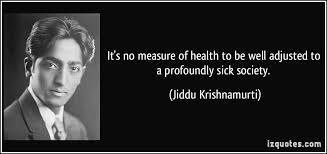
images.jpeg

Over the years of trying to learn what makes average people act the ways they do, the only absolute I have come to is this; the biggest difference between being diagnosed as insane or sane is the number of people involved. It is considered insane to have crippling paranoia or depression. It is considered sane to complain about your shortcomings but do nothing to address said shortcomings. Over the course of the almost three years I have done this alifeofmentalillness blog I have stated on several occasions I would do just about anything to be sane and normal again.  I should be more specific and revise this.  I would give anything to not suffer delusions of persecution, hallucinations, crippling bouts of anger and depression, and the general isolation that comes along with it.  But I do not want to become what most people would consider normal.  By that I mean I do not want to lose my ability for empathy.  From what I have seen out of normals over the years, they seem to have a general lack of empathy or ability to see things from others people’s viewpoints.  I do not want to be uncaring.  It causes a great deal of pain that I sometimes have to be mean and even borderline abusive to people just to get a point across.  I hate being angry and mean to people.  I’m not a natural jerk.  Never have been and never will be.  I don’t know how much of that is the illness and how much of that is my natural personality.  But I absolutely hate being mean and combative to people. If I can’t be pleasant with someone and have them be pleasant to me, I try to avoid that person. To paraphrase Lee Marvin from the classic ‘Paint Your Wagon’ “you don’t have to love thy neighbor if you just leave the poor fool alone.”  But too seldom have I seen anyone, mentally ill or not, just leave other people alone.

Another aspect of sanity I never want to possess is the tendency for group think.  I love having a mind and using it. I hate celebrity gossip.  I hate reality tv.  I hate tabloid journalism.  I’ve even come to hate watching sports on tv because of the base nature of what is modern sports journalism.  It doesn’t bother me that a pro athlete makes more than any worker that isn’t executive management or an entrepreneur.  If I had 50,000 people pay $50 for tickets to read my blogs  or ten million subscribers like some popular youtube personalities, I’d be wealthy too.  Besides, well over half of pro athletes wind up bankrupt within five years of their retirement.  Watch the ESPN documentary ‘Broke‘ to see how true this really is. I am however bothered with how people will build up someone with talent only to knock them down later.  That is why I hope and pray I never become famous or wealthy.  “More money, more problems” as the late Biggie Smalls said.

I love learning new things, which is a skill which will become more valuable than it is now in the coming years and decades as technological and scientific advances get even faster than they are now.  For years I have listened to normals complain about their jobs.  I heard the “Oh God It’s Monday” and “Thank God It’s Friday” memes long before I had even dial up internet.  And I’ve seen and read articles on both domestic and foreign news sites about how potentially we could see job losses to automation with future unemployment rates that would make the 1930s look like a bull market on steroids.  NPR had an interactive article I’m linking to about chances of different types of jobs being taken over by machines and computers.  For example many jobs in customer service will likely be taken over, but many traditional medical and STEM jobs probably won’t be automated anytime soon.  And I bring this up because now many people are fretting over their jobs being taken over by machines.  Seriously?  First you complain about how bad you hate your job.  Now you complain that you may lose said job that you were cursing not even a couple months ago?  Make up your minds, people.  Do you think your current job sucks or do you want to do that lousy job?  Personally I don’t care if the robotics take the jobs I’ve had, providing there is some restructuring to tax laws and social safety nets.  The robots are coming, make no mistake.  They will take a lot of jobs.  Advances can be temporarily delayed but will win out.  Robots and computers will take many, if not most jobs.  How will we address a significant portion of people who identified with their work for their entire lives being unemployed and behind on their payments?  I normally don’t talk politics on this site, but regardless of your political philosophy these are issues that we need to demand our lawmakers discuss, ideally sooner rather than later.

Believe it or not I have worked before, even after I was diagnosed with a mental illness.  I have been a retail clerk, fast food cook, waiter, factory worker, teacher’s aide/graduate assistant, dish washer, janitor, construction worker, farm hand, lawn mower, and newspaper delivery boy (when I was 10 years old).  And everyone of those jobs (with the exception of teacher’s aide) was repetitive, mind numbingly boring, required no creative imagination, and didn’t really make a difference to even my small hometown.  Most of those jobs stand a good chance of being automated within the next twenty years anyway.  So those jobs were drudgery, not stimulating, and I worked mostly with people who were not very creative or intelligent. But those were the only jobs available to me, at least in my small town and rural area.  I can foresee a mass migration out of rural areas and small towns all over the world (more so than now) once automation really gets rolling.  Even I may be going to a big city if enough of my hometown dries up and or stagnates.

Creative jobs will likely become in demand soon.  I liked the teacher’s aide job because I got to interact with above average intelligence people everyday, got to use computers, got to teach a few college courses as a substitute teacher, and was actually encouraged to use my creativity.  Unfortunately that job was contingent on me being a graduate student in the Masters in Business program.  I loved the job but didn’t do well enough in the classes to keep my job.  I could have seen being a computers instructor and research rat for the next fifty  years.  But I can’t because I don’t have that piece of paper that states I am qualified for a job like that.

So here I am living on the fringes of society because of my disability.  Wasn’t my first choice but that is the current system we live under.  I don’t make the rules, I just live by them.  I never wanted to just waist my mind on disability.  But the aspects of the illness that make figuring out office politics and dealing with vicious bosses and coworkers will not allow me to function in our toxic modern work environment.  I don’t see how normals function under such systems.  Perhaps normals do it only by copious doses of reality tv, alcohol, anti depressants, tabloid news channels that don’t report anything that really makes a difference (I watch foreign news casts even more than U.S. news because I don’t care at all about celebrity gossip or what steroid pumped football god beat up his girlfriend this week).  I didn’t like the work environments I was in.  Not because I couldn’t physically or mentally do the work.  Far from it.  I just couldn’t adjust to the environment of toxic coworkers and borderline abusive bosses.

As far as people who think I am lazy and just being a leech off the good tax payers of my nation, I wish to leave you with the following thoughts.

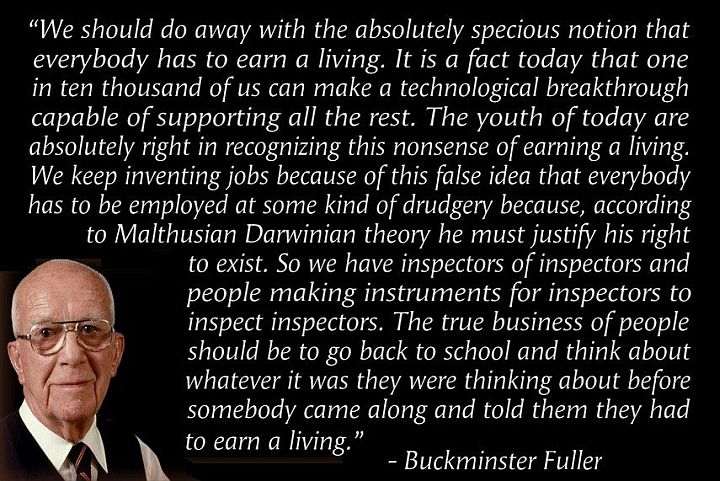
buckminster-fuller-earn-living-technological-breakthrough.jpg

I am definitely not one of the one in ten thousand who can make the breakthrough, perhaps maybe among the one in ten who truly try to appreciate the men and women who make breakthroughs possible.  If it weren’t for brilliant scientists working on psych meds I would be in a padded room in an insane asylum as would some of the coolest people I ever met.  If it wasn’t for medical science my dear mother might be dead because of heart and thyroid problems.  If it wasn’t for scientists and engineers we wouldn’t have the internet, anti biotic drugs, sanitation, etc.  I am grateful every day for the ‘one in ten thousand.’  Everyone should be.