Strong Emotions and Mental Illness

Source: Strong Emotions and Mental Illness

Overcoming Loneliness

Source: Overcoming Loneliness

Loneliness and Delusions

Source: Loneliness and Delusions

Minimalism and The Schizophrenic Mind

Source: Minimalism and The Schizophrenic Mind

A Sense of Normal With Mental Illness

This summer has not been a typical summer for me.  I served as a groomsman in a friend’s wedding.  I lost a grandmother who influenced my life for nothing but the better.  I also got kind of lazy about watching what I ate and gained 15 of the almost 70 pounds I had lost overall.  But I also went through the entire summer with only one flare up of the schizophrenia.  This happened back in early July.

Summers are usually tough times for me.  This is when I feel my most irritable and easily agitated.  Some of my worst flare ups occur in July and August every year like clockwork.  I’ve seen research suggesting that a good portion of people have more problems with mental illness during certain times of year.  I think my problems in summer are made worse by the heat of summer.  It’s a dry heat most of the time in my home state of Nebraska.  When it does rain the humidity can be rough.

Things have been settling down and getting back to more typical for the last three weeks.  I’ve gotten serious about dieting and exercise again and have lost 10 pounds since my grandma’s funeral.  My problems with irritability, anger, and anxiety are subsiding again.  We also had a week when it was unseasonably cool in the middle of August.  It was an early preview of the fall that will be starting in a few weeks.  We haven’t had an unbearably hot summer this year but it was hot enough for several weeks just enough to limit outdoor activity more than I would have liked.

Thoughts on Employment and Education Options While On Disability

GLA7035

I live in a small town that hosts a small state university.  School began for the fall session earlier this week.  Even though I haven’t been enrolled as a student at any school for ten years I still enjoy it when the college kids start back.  Since a significant percentage of my town is either enrolled at the college or works for the college, the town is really quiet, almost dead, for most of mid May to late August.

I went to the campus last weekend for the welcome back street fair.  Got some cool freebies and got to see that practically every student organization, fraternity, academic department, and interest group had a booth and was represented.  Surprisingly I got a lot of freebie handout coupons that we exclusively for students.  Now I’m in my mid 30s so I was quite surprised that I got these deals in spite my obviously not being a student.  But I was getting carded every time I went to a pub to see a concert well into my 30s except for a few times when I had a full beard.  I didn’t think I looked that youthful.  There are days I certainly don’t feel it.  But I wasn’t about to pass up free giveaways.

While I was at this street fair I couldn’t help but think ‘Do this kids really know what’s going on in the world off campus’ and ‘What will these kids be doing ten to fifteen years from now.’  In my case when I went to college back in the pre wireless internet days of 1999, I really didn’t pay that much attention to the world outside the ivy walls of my Christian college.  Like most naive college freshmen I thought that I would get my degree and then do well in the workplace.  Little did I realize that unless you’re majoring in a STEM (Science, Technology, Engineering, Math) field or went to a two year school for a specific trade, college cannot teach you what you need to know for a work place.  Even my friend the high school teacher told me that little of what he learned in his teacher education classes helped him much.  He said concentrating on his subject matter (history and social sciences) and student teaching helped him more than anything he learned in any classroom.

My problem was while I did well in the classroom, I couldn’t make the transition to the real world of work because of my inability to work through stress, crippling anxiety (I literally used to vomit from panic attacks before I went to work even as a minimum wage retail clerk),  inability to read people, and inability to work around office politics.  Would have been good to known this before I sunk five years of my life into college for a degree I would never use in any way, shape, or form.  I am very fortunate to have escaped college debt free.  Most of my classmates weren’t so lucky.  As much as I enjoyed college I would have been far better off going to a two year trade school to learn something like computer networking, web page design, or computer coding.  I would love to go back to school to learn any and all of these three things, but with being on disability insurance I don’t see how that is possible without losing Medicaid.  As it is, my medications cost over $2,000 a month without insurance.  The only way I could go without medications and not be a danger to myself and others is through long term hospitalization.  That’s not really an option as many long term care hospitals have been shut down over the years due to budget cuts and a general move away from institutionalization of mental health patients.

I would love to get into some computer related field, namely webpage design or computer networking.  If there is a way to learn this without getting thrown off the Medicaid entirely I would love to know how.  I’d probably have to do free online classes (if those are recognized by potential employers) as what I make is below poverty level.  I’m tired of being on disability and having to let my mind go to waste.  If anyone from Social Security Disability is reading, you guys are really missing out if you aren’t encouraging people into online studying for jobs that don’t require traditional education.  Besides most jobs do not require a four year degree if it wasn’t for the artificial barrier to entry it created.  Most employers I talked to said that most jobs could be learned with a year of intense on the job training or less.  If the U.S. Air Force can turn recruits into great pilots in less than two years, then it realistically doesn’t take four years of college to learn data entry or any other entry level office job.

In closing I want to work, especially at something like web page design.  I am definitely open to the idea of working from home (commuting even five minutes to my old courthouse job got old), would prefer it actually.  I don’t want to spend the rest of my life on disability and squander my mind and creativity.  And I think it’s insane that we, at least here in the USA, have a disability system that makes it confusing, frustrating, and almost impossible to return to productive work without a mountain of paper work and a maze of hoops to jump through.  It shouldn’t take acts of Congress and God both to return people who want to work back.  And frying chicken at KFC for minimum wage is not a viable career option for thirty to forty years of a working life.

Managing Money With A Mental Illness

one-69528_640

Money.  It’s something we all think about, worry about, and use on a daily basis.  But for something that is so important to our lives, it is something only a few really know how to use and manage.  We often think that ‘if only I had more money’ or ‘if things didn’t cost so much’ we would be happier and better off.  No we wouldn’t.  A person could make twice as much as they do now, yet if they don’t keep their spending and consuming in line, they’ll spend every last cent they have.  What you make or don’t make is not as important as how much we spend and even keep.  Those of us living in the more developed countries can live pretty decent on what we make as long as we know what we’re spending on what, make sure what we spend is less than we make, and even set aside some money for emergencies or other purposes.

Some keep saying if only I had more money.  What you make doesn’t really matter if you keep spending more than you make and have to rely on credit cards or pay day loans just to make it to the next payday.  I personally live pretty decent on what little I make just from my disability pension.  But this is because I got deadly serious about budgeting my limited money and got out of debt.  I’ve been completely debt free for right at a year.  But it’s only because I stick to my budget.  I write out my budget every month and decide how much I spend for food, fuel and maintenance for my car, household expenses, clothing, and minor miscellaneous items after my rent is covered.  It is possible to live on just a disability pension as long as you get out of debt and control your expenses.  Yes this means passing on some things.  Yes this means hunting for bargains.  Yes this means shopping for clothes at Goodwill or Wal-Mart instead of The Gap or Neiman Marcus.  There is no point in looking good if it puts you in debt to a credit card company or a pay day loan place.  There is no reason to keep up with your neighbors or friends when they are behind on their rent and their relationships are falling apart because they aren’t managing their money well.  Such people who look good even when broke are what a friend of mine from Texas called ‘Big Hat but No Cattle.’

The best bit of advice I can give to those with a mental illness, or any disability, who are living on a disability pension and/or working a low paying job and struggling to make ends meet are 1) Make a budget and track every dollar you make and 2) Get out of debt and stay out of debt.  You might think you can limp along  as long as you keep getting your checks or the job keeps up.  But those pensions could possibly get reduced, just like what is happening in Greece, Cyprus, Argentina, and any number of countries that for whatever reasons got overextended and mismanaged their finances.  My USA is no exception, we overextended ourselves not just through military spending but by promising everyone who asked what they wanted without planning on how to pay for it.  The biggest lie we tell ourselves is that we can ‘have it all.’  In all honesty, we have to pick and choose what we get because we and our resources are finite and limited.  Many of our current problems, as individuals, businesses, and governments wouldn’t be having the instabilities and problems we have if we merely didn’t spend more than we bring in.

But to get out of debt, you may have to do some drastic things.  You may have to give up enjoyable things.  You may have to give up smoking, drinking, lottery tickets, electronic trinkets, move to a cheaper place, maybe even reconcile with family and ask them for help.  If you are behind on your payments, talk to those you owe money.  Tell them everything and see if you can work something out.  Some may even be willing to clear some of your debt, but that is not a license to go back and do the stupid things that got you into trouble to begin with.  Look at it as the real life ‘Get Out Of Jail Free’ card.  Yes, it will be tough going for awhile.  It will suck when you can’t go to restaurants or the bar with your friends.  It won’t be glamorous at all.  But if you are in trouble money wise, you need to get out of debt and adhere to a budget by any means necessary.  I was and I had to do some major adjustments that short term really sucked.  But they paid off long term.  I don’t worry about sending money to a credit card company.  I don’t worry about if I can make rent because I know I can.  I even manage to put some of my disability pension into an emergency fund.

It would have been great if we learned how to manage money and budget in our formal education.  But we didn’t so we have to learn it now as adults.  And yes this is required.  Money by itself is not evil any more than wheat seeds and livestock were in farming societies in ancient times.  Money is the tool of survival in the 21st century.  We all would be wise to learn how to manage it better.  Good authors to read on money management are out there, as are youtube videos.  My personal favorites include Dave Ramsey and Suze Orman.  Check some their work out.

Why I Am Grateful For Tech And Science Advances

Just a few days ago I was chatting with one of the older residents in my complex and the subject of technology and scientific advances came up.  He made the statement to the effect that ‘besides making people easier to monitor, manipulate, and kill, tech advances have done little for the betterment of humanity.’  I wanted to laugh at this short sighted statement. How forgetful and often ungrateful we can be.  I’ve alluded to tech advances by and large improving things for people in previous posts.  In one I made the parallel between what technologies we in 2015 take for granted and what various U.S. presidents didn’t have (i.e. Jefferson not having railroads, Lincoln not having electric lights or telephones, FDR never having a credit card, JFK never having a microwave oven, etc.).  And these were things I just came up with at a moment’s notice.

There are drawbacks at times but these are often offset by the benefits of advances over previous techs. Sure antibiotics are often over used and can make some people less resistant to future sickness.  But how many people on this planet that are living full, content, and productive lives that would have died if it weren’t for the development of antibiotics to begin with?  Or automobiles?  Who seriously wants to go back to the late 1800s when cities like London and New York where having problems with the stench, diseases, flies, and rodents that resulted from entire lots piled high with horse manure?  I grew up around farming and often worked on my uncle’s farm during the summers.  I can tell you that farm animals like horses, cows, and pigs eat lots of grains and hay.  Since cars don’t eat wheat or hay, that frees up lots of crops to go to humans.  Yeah, I get the whole ethanol being made from corn argument.  But ethanol can be made from switch grass, sugar cane or anything else that ferments.

Another place I’m grateful for tech advances is in the field of medicine and health.  The two anti psychotic medications I’m currently taking weren’t available even in 2010.  And they have fewer side effects and the ones they have are less severe.  My current medications aren’t as bad in terms of promoting weight gain.  One medication I was on several years ago had sore joints and sleepiness as one of the side effects.  But because of the options made available due to advances in medical science I was able to switch to something different and the side effects went away quickly.  As far as the argument that psych meds promote mental health problems, have you looked at the history of mental illness treatments?  Before the 1950s about the only options for someone with my diagnosis were long term hospitalizations and electroshock therapy.  If I were born even in 1920 instead of 1980 with my mental health problems I would have either been long term hospitalization, homeless, or dead.  For the first three years of my mental illness problems I wasn’t on any kind of treatment.  Went through the last two years of public high school and the first year of college dealing with constant paranoia, depression, anxiety, and anger.  I was far more short tempered, argumentative, and paranoid without treatment.  It’s a wonder I didn’t assault one of my classmates or anyone else.

To suggest that modern medical tech advances have made us less healthy and lowered our quality of life is not only false, it’s stupid. Some will argue that we have more cases of cancer now than we did three generations ago.  For starters we have more people and people are living longer now than three generations ago.  In 1900 the average life expectancy even in USA and Western Europe was maybe 50.  Now we in USA complain that life expectancy is ‘only’ in the late 70s when in some places like Japan it’s the lower 80s.  Even in some of the poorer countries in Africa life expectancy is in the late 50s and even early 60s and that is with AIDS pandemics and civil wars. In the early 1900s these same regions life expectancy was in the early 30s.  Cancer is one of those things that the chances of getting go up with age.  My grandfather died of pancreatic cancer but he was 87 years old too.  He also had serious hepatitis during the 1940s.  Had he gotten that in the 1860s instead of the 1940s, he might not have lived past his twenties. What is worse, dying from a stroke at age 70 or dying from chorlea at age 25?

Some my argue that tech advances have led to the breakdown of the traditional family unit.  I know the stats state that divorce rates in many first world nations are at 50 percent or higher.  But traditionally many people were married more than once in their lives.  Men often remarried and had mixed families, not due to divorce, but because their wives dying from childbirth or any number of illnesses.  Women often remarried because of their husbands dying in wars, work related accidents, or illnesses.  If we were to take the numbers there are probably more people making to their 50 year anniversary celebration now than even 60 years ago, again due to more people and better health.  And sometimes men married more than once because they had more than one wife at a time.  Polygamy and not having one mate for life are as old as life itself.  It could be possible that someday, thanks to advances in medical tech, we could be seeing couples have 100th anniversary parties like some people have 60 year anniversary parties now.  What would you get a spouse who has been with you for an entire century?

I could go on but I won’t.  But we are often forgetful and even less than grateful.  I for one am grateful for tech advances.  I would love to see scientists, engineers, researchers, and health care workers get the attention that the media reserves all too often for politicians, musicians, and star athletes.  But that is probably not going to happen simply because bad news sells better than good.  Yet if you are a scientist, engineer, health care worker, researcher, or anyone who works to provide the essentials for modern living, I am thankful for all you men and women.  Keep up the good work.  If you are so inclined to see actual data on advances in health, wealth, and overall well being, check out humanprogress.org.

Dealing With A Death In The Family While Having Mental Illness

On Tuesday, August 4th my paternal grandmother died in her sleep a few days after having a major stroke.  She was 97 years old.  Grandma Foster was one of these people who was always looking out for other people almost like they were her own kids.  I can imagine as the oldest of eight siblings growing up on a farm in Nebraska during the Great Depression she would have developed those skills of caring for others and making that a huge part of her life at an early age.

Every summer my brother and I would spend a few days with her in her hometown.  After my Grandpa Foster died of a heart attack at their farmstead in the early 1980s she moved into town.  While I can’t remember the farmstead she, grandpa, and my dad lived on, she and my dad both used to tell us stories about life on their farm.  Grandma was one of these farmers’ wives who could do a little bit of everything.  She said she could have taken a chicken from the henhouse and cooked on the dining room table in about an hour.  She also did quite a bit of the same farm work my grandpa was doing during the first few years of their marriage right alongside him out in the field.  This was back in the late 1930s when  the corn crops where still being harvested by hand well into the winter.

During World War II, after my grandfather couldn’t qualify for the army as in enlisted soldier because of his age, grandma and grandpa went to Wichita, Kansas to work in an aircraft factory.  They both worked in that factory for the duration of the war.  A few years after the war ended the family moved back to Nebraska.  My grandpa farmed for the rest of his life.  It wasn’t until a few years ago that I realized that grandpa and grandma never owned their own land and instead farmed for others.  In addition to being a farm wife and a worker in a aircraft factory, Grandma Foster worked for a number of years as a payroll clerk in an automotive parts plant.  In the 1960s and 1970s she was filling out those payrolls by hand, doing several hundred of those every two weeks.  She didn’t have much time to enjoy retirement before grandpa had his heart attack but she did enjoy having her grandkids and the kids of her extended family around as much as possible.

Even though I have been fighting a mental illness for my entire adult life I’m not as distraught by her death as I thought I would be.  That might be changing soon as my dad, my brother, and I will be spending the weekend cleaning out her apartment.  I’m also going to be one of the pall bearers.  I was a pall bearer at my maternal grandmother’s funeral too.  But as I have been working with a mental illness for quite some time I know myself well enough that often anticipating some bad event will not only lead me into a downward spiral, the anticipation will be worse than the event itself.

So as of right now I’m not thinking about cleaning out the apartment or the funeral or being a pall bearer or the visitation the night before the funeral.  It helps that we had a small birthday bash for her a couple of months ago and she was as mentally sharp as ever then.  She had been hampered by arthritis for the last several years that made walking without a walker or a cane very tough.  As much of an extrovert as my grandmother was this had to be tough.  But she managed to stay in contact with her many friends and family members through Facebook and phone calls.  She was one of these who wasn’t afraid to use new technologies while not losing the old style compassion and empathy for others.  Grandma used her Facebook account to show her caring and to keep others aware of what went on in their social circles.  A couple years ago she said that she went from being in awe of the Ford Model T to looking at flying drones just in her lifetime.  Who knows what my nephews and niece will see in theirs.

At this moment I’m not completely torn up that this compassionate sweet lady has died and is leaving a void that will have to be filled by others.  In time that void will be filled by others in our family and among her friends as it is natural for others to step into rolls that others filled after a death.  Rather than being distraught about her death, I’m grateful that she and those like her lived and impacted as many people as they did.

Purpose and Agency

abraham-maslows-hierarchy-of-needs1.preview

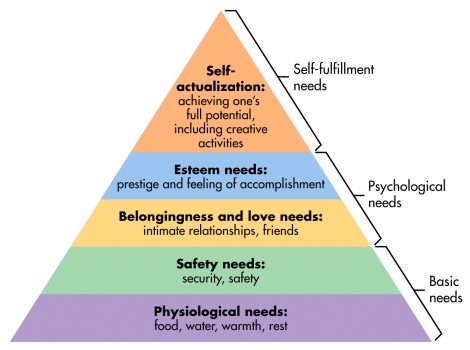
This blog entry is going to be about the importance of finding a purpose for your life and having agency.  By agency I mean finding something that you can do with your given skill set that gives your life meaning.  We as humans do not exist in a vacuum.  We have to interact with other people and the environment around us.  How we interact can either be beneficial or destructive.  I have found if I just try being neutral and not standing out I become miserable.  I cannot go through life without working toward some goal. I have to have something to work toward or even work against.  I get lost into thinking ‘why am I here’ if I have no purpose.  This is true of all people, especially men.  That is why we throw ourselves into our jobs, our hobbies, our projects, our families, and our beliefs.

Having a purpose can be either good or bad.  Having good, constructive, and beneficial purpose leads people to build businesses, create great works of art, think up great ideas no one else came up with, and strive to better the lives of others.  Bad and destructive purpose, however, can lead people into joining street gains, terrorist groups, crime syndicates, and commiting atrocites.

I think of people as bundles of energy.  Direct them into things that allow them to channel energy into creative endeavors and you’ll ultimately wind up with civilization and means to improve civilization.  Yet do not allow them to channel energy into creative purpose, it will be expressed in destructive acts and chaos.  Part of me fears the reason we are seeing so many heinous acts of violence like the recent shootings in South Carolina, Tennessee, and Louisiana is that many people, especially younger men, feel like they have no place or purpose.  Granted not all people are not going to resort to murder or joining groups like ISIS because they don’t have a life mission or they feel they aren’t making a difference.  Others may be using their pent up energy to less obvious destructive means, such as small time hustling, petty crime, or even computer hacking and internet trolling.  It could be possible that one of the reasons that mental illness is becoming prevalent is that many people no longer feel they have a purpose or belong to anything bigger than themselves or no longer feel connected to their communities.

One of the things that gives me agency is writing this blog.  I write to explain mental illness to others who don’t know it personally.  I blog to give advice to others with mental illness who may be recently diagnosed or having serious problems for the first time and not know what is going on or what to expect.  I write to be an encouragement to others who, like myself, have been dealing with mental illness for awhile and still have ups and downs.

As my Definite Chief Aim, to borrow a term from Napoleon Hill, I am seeking to inform and enlighten others as what having a mental illness is like from the mentally ill person’s point of view.  I have always done well at explaining ideas and concepts to others and I have no fear of speaking up in public.  And there is a percentage of the general population who has mental illness, I think close to 5 percent for serious, chronic mental illnesses like schizophrenia, bipolar, autism spectrum, major depression, borderline personality disorder, etc.  Many of these mentally ill individuals are unable to express the issues of their illnesses.  This is where I, and other bloggers come in.

If I were asked what I am working against, it would be ignorance and cruelty.  Too many people don’t know what mental illness is like for us or what a hinderance it can be.  Some people even refuse to acknowledge it even exists.  Yes, it does exist.  I, and others like me, are not making up our problems with crippling anxiety, our problems with alternating between crushing sadness and euphoria, or dealing with delusions to where we have to work to distinguish between what is reality and what is within the constraints of our troubled minds.  We do not make up these problems because we want attention or we are angry about our childhoods.  Our issues are not simplistic type problems that can be overcome only by feel good memes and other quick fixes that try to put a Band Aid on a gushing wound.

It is an understatement to say I do not respect ignorance and cruelty.  We live in an age of nearly unlimited information on any topic imaginable.  I have far more information at my fingertips through a $400 laptop computer and $32 a month wireless internet service than the scholars who set up the Great Library of ancient Alexandria could have imagined even possible.  Medieval scholars would have killed, and sometimes were killed, for having access to a tiny fraction of a fraction of the information I can call up at a whim.  There are no more excuses for being ignorant.  In 2015, ignorance is not a matter of destiny, it is a matter of choice to paraphrase William Jennings Bryan.

In closing, writing and researching for this mental illness blog gives me some sense of agency and purpose.  Ignorance and the resulting cruelty are two of the ‘enemies’ I ‘fight’ against.  We all have things we are passionate about.  We all have things we can do for others and ourselves.  It is a matter of finding those things that give us agency and purpose and then going to work.