Thoughts on Employment and Education Options While On Disability

GLA7035

I live in a small town that hosts a small state university.  School began for the fall session earlier this week.  Even though I haven’t been enrolled as a student at any school for ten years I still enjoy it when the college kids start back.  Since a significant percentage of my town is either enrolled at the college or works for the college, the town is really quiet, almost dead, for most of mid May to late August.

I went to the campus last weekend for the welcome back street fair.  Got some cool freebies and got to see that practically every student organization, fraternity, academic department, and interest group had a booth and was represented.  Surprisingly I got a lot of freebie handout coupons that we exclusively for students.  Now I’m in my mid 30s so I was quite surprised that I got these deals in spite my obviously not being a student.  But I was getting carded every time I went to a pub to see a concert well into my 30s except for a few times when I had a full beard.  I didn’t think I looked that youthful.  There are days I certainly don’t feel it.  But I wasn’t about to pass up free giveaways.

While I was at this street fair I couldn’t help but think ‘Do this kids really know what’s going on in the world off campus’ and ‘What will these kids be doing ten to fifteen years from now.’  In my case when I went to college back in the pre wireless internet days of 1999, I really didn’t pay that much attention to the world outside the ivy walls of my Christian college.  Like most naive college freshmen I thought that I would get my degree and then do well in the workplace.  Little did I realize that unless you’re majoring in a STEM (Science, Technology, Engineering, Math) field or went to a two year school for a specific trade, college cannot teach you what you need to know for a work place.  Even my friend the high school teacher told me that little of what he learned in his teacher education classes helped him much.  He said concentrating on his subject matter (history and social sciences) and student teaching helped him more than anything he learned in any classroom.

My problem was while I did well in the classroom, I couldn’t make the transition to the real world of work because of my inability to work through stress, crippling anxiety (I literally used to vomit from panic attacks before I went to work even as a minimum wage retail clerk),  inability to read people, and inability to work around office politics.  Would have been good to known this before I sunk five years of my life into college for a degree I would never use in any way, shape, or form.  I am very fortunate to have escaped college debt free.  Most of my classmates weren’t so lucky.  As much as I enjoyed college I would have been far better off going to a two year trade school to learn something like computer networking, web page design, or computer coding.  I would love to go back to school to learn any and all of these three things, but with being on disability insurance I don’t see how that is possible without losing Medicaid.  As it is, my medications cost over $2,000 a month without insurance.  The only way I could go without medications and not be a danger to myself and others is through long term hospitalization.  That’s not really an option as many long term care hospitals have been shut down over the years due to budget cuts and a general move away from institutionalization of mental health patients.

I would love to get into some computer related field, namely webpage design or computer networking.  If there is a way to learn this without getting thrown off the Medicaid entirely I would love to know how.  I’d probably have to do free online classes (if those are recognized by potential employers) as what I make is below poverty level.  I’m tired of being on disability and having to let my mind go to waste.  If anyone from Social Security Disability is reading, you guys are really missing out if you aren’t encouraging people into online studying for jobs that don’t require traditional education.  Besides most jobs do not require a four year degree if it wasn’t for the artificial barrier to entry it created.  Most employers I talked to said that most jobs could be learned with a year of intense on the job training or less.  If the U.S. Air Force can turn recruits into great pilots in less than two years, then it realistically doesn’t take four years of college to learn data entry or any other entry level office job.

In closing I want to work, especially at something like web page design.  I am definitely open to the idea of working from home (commuting even five minutes to my old courthouse job got old), would prefer it actually.  I don’t want to spend the rest of my life on disability and squander my mind and creativity.  And I think it’s insane that we, at least here in the USA, have a disability system that makes it confusing, frustrating, and almost impossible to return to productive work without a mountain of paper work and a maze of hoops to jump through.  It shouldn’t take acts of Congress and God both to return people who want to work back.  And frying chicken at KFC for minimum wage is not a viable career option for thirty to forty years of a working life.

Purpose and Agency

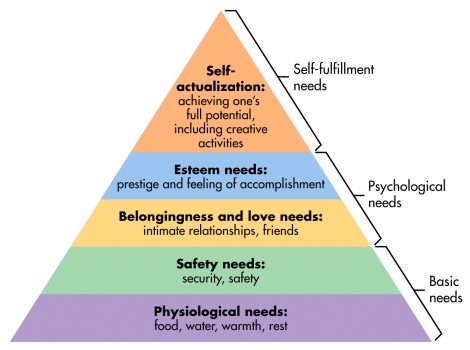
abraham-maslows-hierarchy-of-needs1.preview

This blog entry is going to be about the importance of finding a purpose for your life and having agency.  By agency I mean finding something that you can do with your given skill set that gives your life meaning.  We as humans do not exist in a vacuum.  We have to interact with other people and the environment around us.  How we interact can either be beneficial or destructive.  I have found if I just try being neutral and not standing out I become miserable.  I cannot go through life without working toward some goal. I have to have something to work toward or even work against.  I get lost into thinking ‘why am I here’ if I have no purpose.  This is true of all people, especially men.  That is why we throw ourselves into our jobs, our hobbies, our projects, our families, and our beliefs.

Having a purpose can be either good or bad.  Having good, constructive, and beneficial purpose leads people to build businesses, create great works of art, think up great ideas no one else came up with, and strive to better the lives of others.  Bad and destructive purpose, however, can lead people into joining street gains, terrorist groups, crime syndicates, and commiting atrocites.

I think of people as bundles of energy.  Direct them into things that allow them to channel energy into creative endeavors and you’ll ultimately wind up with civilization and means to improve civilization.  Yet do not allow them to channel energy into creative purpose, it will be expressed in destructive acts and chaos.  Part of me fears the reason we are seeing so many heinous acts of violence like the recent shootings in South Carolina, Tennessee, and Louisiana is that many people, especially younger men, feel like they have no place or purpose.  Granted not all people are not going to resort to murder or joining groups like ISIS because they don’t have a life mission or they feel they aren’t making a difference.  Others may be using their pent up energy to less obvious destructive means, such as small time hustling, petty crime, or even computer hacking and internet trolling.  It could be possible that one of the reasons that mental illness is becoming prevalent is that many people no longer feel they have a purpose or belong to anything bigger than themselves or no longer feel connected to their communities.

One of the things that gives me agency is writing this blog.  I write to explain mental illness to others who don’t know it personally.  I blog to give advice to others with mental illness who may be recently diagnosed or having serious problems for the first time and not know what is going on or what to expect.  I write to be an encouragement to others who, like myself, have been dealing with mental illness for awhile and still have ups and downs.

As my Definite Chief Aim, to borrow a term from Napoleon Hill, I am seeking to inform and enlighten others as what having a mental illness is like from the mentally ill person’s point of view.  I have always done well at explaining ideas and concepts to others and I have no fear of speaking up in public.  And there is a percentage of the general population who has mental illness, I think close to 5 percent for serious, chronic mental illnesses like schizophrenia, bipolar, autism spectrum, major depression, borderline personality disorder, etc.  Many of these mentally ill individuals are unable to express the issues of their illnesses.  This is where I, and other bloggers come in.

If I were asked what I am working against, it would be ignorance and cruelty.  Too many people don’t know what mental illness is like for us or what a hinderance it can be.  Some people even refuse to acknowledge it even exists.  Yes, it does exist.  I, and others like me, are not making up our problems with crippling anxiety, our problems with alternating between crushing sadness and euphoria, or dealing with delusions to where we have to work to distinguish between what is reality and what is within the constraints of our troubled minds.  We do not make up these problems because we want attention or we are angry about our childhoods.  Our issues are not simplistic type problems that can be overcome only by feel good memes and other quick fixes that try to put a Band Aid on a gushing wound.

It is an understatement to say I do not respect ignorance and cruelty.  We live in an age of nearly unlimited information on any topic imaginable.  I have far more information at my fingertips through a $400 laptop computer and $32 a month wireless internet service than the scholars who set up the Great Library of ancient Alexandria could have imagined even possible.  Medieval scholars would have killed, and sometimes were killed, for having access to a tiny fraction of a fraction of the information I can call up at a whim.  There are no more excuses for being ignorant.  In 2015, ignorance is not a matter of destiny, it is a matter of choice to paraphrase William Jennings Bryan.

In closing, writing and researching for this mental illness blog gives me some sense of agency and purpose.  Ignorance and the resulting cruelty are two of the ‘enemies’ I ‘fight’ against.  We all have things we are passionate about.  We all have things we can do for others and ourselves.  It is a matter of finding those things that give us agency and purpose and then going to work.

Washing Out of Graduate School, Having Mental Health Issues, and Chains of Events (Or The Story of My Adult Life)

If I were to meet anyone who has been diagnosed with mental health problems and he/she were looking for advice as to what to do from the diagnosis onward, it would be 1) Don’t Give Up,  2) Look for what you are naturally good at despite your problems, and 3) Get Really Creative. 

In this entry, I’m going to tell some of my personal story from the last several years. It’s a short autobiography of sorts. In February of 2006, after having washed out of the MBA program at a small state university, I decided to apply for Social Security Disability Insurance.  I had recently lost my graduate assistantship due to my grades.  It wasn’t that I didn’t like my classes or hate my work with the university.  Far from it.  I absolutely loved the work of being a research assistant, tutor, seminar presenter, and occasional substitute teacher.  Yet my mental health issues were flaring up during this time.  I would have been allowed to stay in school in hopes that I could raise my grades and get back on track.  But the prospect of going to school without a job and no way but loans to pay for it while taking on my mental health issues just didn’t appeal to me.  I was able to get through undergraduate college without any debt thanks to academic scholarships, working full time during the summers, and the much appreciated assistance of my family.  I was afraid that taking on the burden of continuing graduate school with no guarantee of getting my grades back up, having to go deep into debt to continue said studies, all the while combating mental health problems and being a financial drag on my family (who were already paying through the nose for the high risk health insurance I was on for meds that otherwise would have cost almost $2,000 monthly); all of it would have been major problems that simply were not worth it.

Looking back on it, I believe I could have completed the MBA program had it not been for the mental health burdens.  But, like almost everyone, I simply didn’t have the unlimited funds to cover medications, health insurance, and retaking the two classes I didn’t do well at all in.  Yet, knowing myself better now at age 33 than I did at age 25, I know I would have been unhappy with being another cubicle bum jockeying for dollars.  Even though I appreciate money as much as anyone I know, I also know it isn’t my only motivator or even one of my primary motivators.  I have found, over the last several years of experience and looking for tendencies in my life going back to before I even started elementary school, that I really enjoyed sharing what I learned with others and giving advice.  If I did complete the MBA program and then become something like a financial analyst, I wouldn’t have been meeting my need to share what I learn to others and helping others avoid problems.  I love explaining things to people, assisting people, and looking up things I don’t know.  I always have.   Had I been able to stay on the ‘traditional’ path, I would be miserable at a cubicle job but would still have my personality slants I mentioned above.  I would have probably then gone on to attempt to get a PhD just so I could teach at even a junior college. I probably would have been doing what I loved, but would have had a rough road to get there.  But to quote Eric Church, “Thank God I ain’t what I almost was.”

Instead, due to circumstances beyond my control, I was forced to become competent in areas besides business and economics.  While I am not an expert on treating mental health problems and issues in others, I have over the years become quite knowledgeable on how to survive with mental health problems and issues.  In the process, I was able to work a part time job for over four years.  I have, thanks to being on Social Security and having the earnings limitations that come with being on Social Security, become knowledgeable on how to survive on what most people in the Western world would consider below poverty level existence.  I have learned how to ‘stretch a dollar’ far further than one could learn in any business school.  Thanks to following my natural love of telling stories, explaining things to people, and reading, I am also a self taught writer.  I have been writing seriously for only ten years as it wasn’t something I acted on until I was almost out of undergraduate college.  Because of my mental health issues, my natural empathy for other people, and my natural desire to share what I learned, I eventually came to write about my experiences with mental health problems and issues.  Many of these writings have found their way onto this blog, The Writing of Life.  I may not have a string of letters behind my last name that ‘qualifies’ me as a trusted expert, at least not in the traditional academic sense.  But with my experiences with my own mental health problems combined with my writing skills and the power of the internet in the Information Age, I can fulfill my natural talents and perhaps help some people in the process.

I have no idea where my life’s journey will go from here.  But this blog will be part of it regardless.  In only seven months of having a definite focus in my blog, I have had over 1,500 visits already.  Though there are bloggers that get that even on a bad day, this is already more than I would have expected when I started. And that’s with sometimes infrequent posts.  Being somewhat risk adverse by nature, I never would have started the process of becoming a mental health advice blogger had I never been forced to change directions.  Yet “Thank God I ain’t what I almost was.”